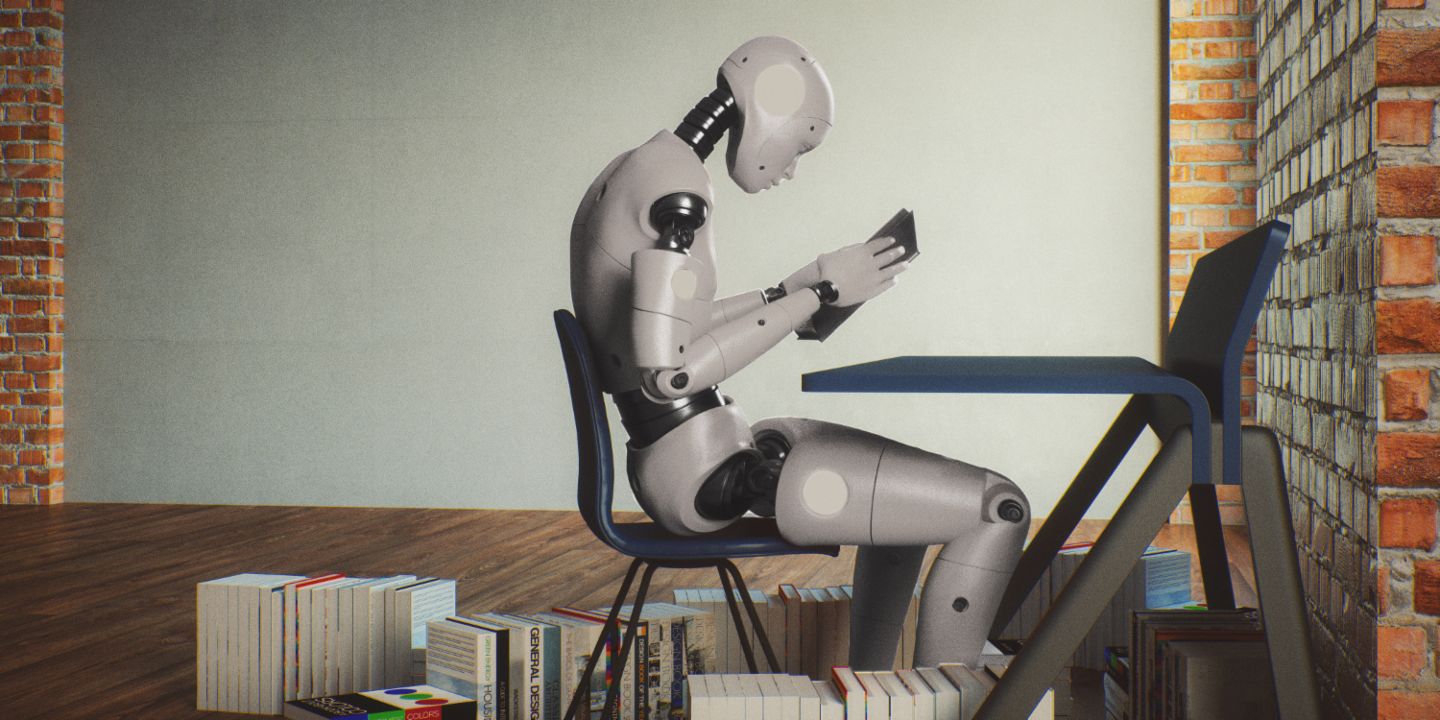
Artificial intelligence gains acceptance: What differentiates weak AI from strong AI.
Artificial intelligence (AI) has been a hot topic for quite some time now. It seems every app and every new electronic device has integrated it these days, and every company wants to use it for their purposes. If you take a closer look, you will see that in most cases, AI is still in its infancy. EOS is currently focusing on the transition from weak AI to strong AI. But what does this actually mean?
- Artificial intelligence eases the workload considerably for data-driven companies.
- Furthermore, self-learning artificial intelligence systems are capable of making strategic decisions based on complex data structures.
- EOS is currently working on the transfer of its debt collection AI to obtain even better prognoses in future.
Not everything with the letters AI on it is actually equipped with AI. Dr. Malte Zuch, Lead Data Scientist at the EOS Center of Analytics (CoA) is also well-aware of this: “Artificial intelligence is associated with a whole range of marketing buzzwords.” While the majority of intelligence systems up to now have had to be trained using historical data, Zuch now feels the time for self-learning systems has come. But everything in its turn.
From if-then systems to superhuman intelligence.
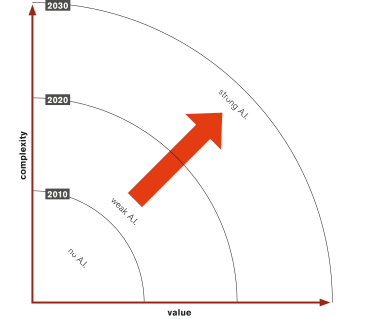
“The evolution of artificial intelligence can be roughly divided into three phases. The topic of AI first gained momentum around the turn of the millennium. According to Malte Zuch, “often, it was not artificial intelligence in the strict sense of the term but rather hard-coded, rule-based systems. Only since the second decade, from about 2010, have systems been increasingly used that we refer to as AI today. They are able to independently classify complex data sets or derive values from them. They are trained in advance with practice data sets, which is why people also speak of “supervised learning”. Examples include the dynamic pricing systems on popular travel platforms or personalized purchase recommendations in online shops.
According to Zuch’s diagram, the decade of “weak” AI ends this year: “The next ten years belong to “strong” AI, which is far superior to human beings with its abilities. One example is the identification of breast cancer: already today, artificial intelligence often obtains more accurate results than experienced doctors.” Reinforcement learning is the key term. With this method, intelligence systems learn independently how to process complex data and to make strategic decisions based on this. A feature that can be invaluable for companies that process data on a daily basis.

AI is entering a new age – and EOS is following suit.
“Our vision is to become a technology-driven financial investor,” explains Malte Zuch. In the past he was part of the developing team of a new AI-based debt collection system. It goes by the name FX and is designed to support employees in processing by finding the most promising strategic course of action for contacting the person in question. Additional applications are already in the planning.
The focus of the research by Zuch’s team is on transitioning from weak to strong artificial intelligence. The learning process of this kind of AI is comparable to that of a child. At the beginning, it knows practically nothing.
All it knows is its surroundings. In real terms, this may be the legal frameworks or the boundaries of its own company within which the AI can move. Otherwise it doesn’t follow any rules at all but decides solely on the basis of its self-learned knowledge base. Through non-stop testing, it gains experience by trial and error. It is able to differentiate between good and bad experiences and takes note of every single test that resulted in the different experiences. The program may seem completely inept at first. However, its performance becomes more precise and ambitious with every test run, until in the end, a superhuman intelligence system emerges that can independently make the right strategic decisions, even in the most complex situations.
Pursuing new avenues, questioning established systems.
In a demo game, Malte Zuch and his team illustrated how efficiently this kind of software can work compared with its rule-based historical predecessors. A playing field is displayed, which represents the business world of EOS. Yellow fields indicate the receivables of which the AI, the black square, should realize as many as possible within 100 steps. At first, the problem looks trivial – the challenge, however, is that the artificial intelligence has to independently learn “survival” in a randomly generated environment without any prior knowledge. After just one night in training, it is already in a position to successfully navigate over two thirds of the receivables.
Of course, this is just a highly simplified prototype. However, it impressively demonstrates what AI is capable of if not “preloaded” with any habits or previous experiences but is given space to try things out. One prominent example of this technology is the computer program AlphaGo, developed by DeepMind, a company that belongs to Google. It not only taught itself the highly complex board game Go, but was also quickly capable of competing against the best players in the world. By trying out quite a few moves beforehand, it amazed viewers with strategies that even long-time Go players had never seen before. Malte Zuch also finds it “impressive”. “It seems that innovation only comes about by questioning rules.” A quality that is indispensable for the development of artificial intelligence .
Photo credits: Getty Images / E+, EOS
Fedezzen fel többet az EOS-tól