What does a Data Analyst do?
Large volumes of data come with a lot of responsibility. The profession of Data Analyst is one of the most interesting lines of work in the big data era.
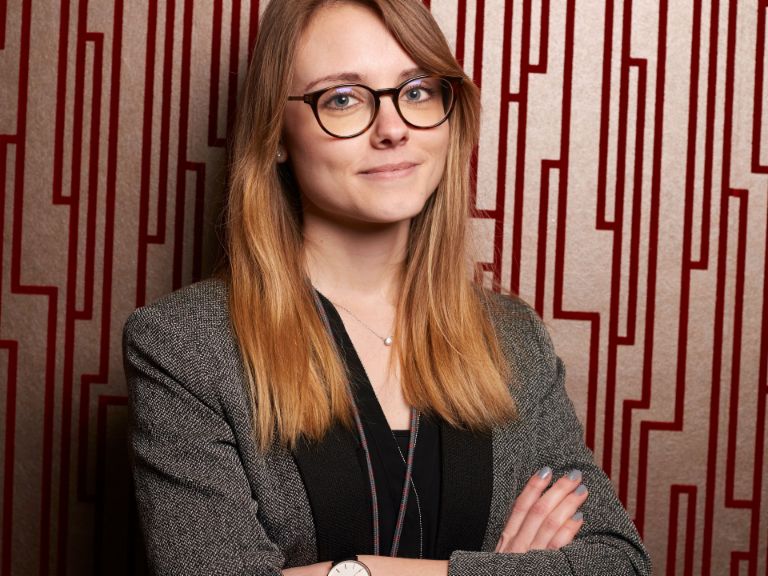
“At some point I started to enjoy rummaging around in mountains of data,” says Marie-Laure Jacobs. “If you look long enough, you recognize patterns and underlying trends that can explain a lot.”
The 25-year-old works as a Data Analyst at EOS Aremas in Belgium, a company that buys and manages receivables. The company, which is based in Brussels, buys outstanding debts from banks and other partners. These might consist of overdue loans, for example, or invoices where companies no longer want to wait for payment. EOS then endeavors to recover these outstanding receivables step by step. Marie-Laure Jacobs’ job in this process is to help her colleagues optimize their collection strategies: “If the recovery of the receivables is not going as planned, I analyze the data in the portfolio to see what the problem is,” says the Belgian native. “And if the team is over budget I can also investigate the reason for this.”
Data analytics is precision work.
Jacobs was still at school when she discovered her passion for numbers, maths and statistics. At the renowned French-speaking University of Liege, she first obtained a Bachelor of Engineering and Business Administration followed by a Master of Financial Engineering.
In 2016 she joined a management consultancy in Brussels as a risk consultant, where for the first time she was able to work with the mountains of data that have fascinated her ever since. Her job was to develop risk models for a bank. Instinctively she was asking the questions that are important in the field of data analytics: “For example, I asked myself if the available data could be conclusive or whether information was missing that somehow needed to also be taken into account.” She was so enthusiastic about handling large volumes of data that she kept looking for a position as a Data Analyst. “And it was precisely at that time that EOS Aremas advertised a job vacancy that was the perfect fit for me,” she recalls. She applied for the job in March 2018 and started working at EOS in June.

There are always new problems to solve.
As the only analyst in a five-strong team, Jacobs has a lot to do and is already at her desk at 8 am. The job involves a lot of work, but also a lot of variety: “Every month we produce a dashboard measuring the success rate for collecting the receivables from the various debt portfolios,” she says. In this context there are constantly new facts to analyze. “The basic challenge is always to translate the operational requirements of my colleagues into a data readout.”
She is proud of a project that she is working on alongside her usual job: a computer-assisted model she developed herself that is designed to help prioritizing cases EOS should work on first. “The model uses a set of features, for example the region where the debtor lives”, she explains. “The whole thing is based on data that show that defaulting payers in some regions of Belgium pay sooner than in others.”
If you base an analysis on incorrect data you will get the wrong answer. It’s that simple.

Three months of programming and then a year of testing.
This means that Jacobs’ model can scour through a portfolio and categorise the debtors according to the likelihood of prompt repayment. On the basis of this data, the collection agents can then determine their strategy for recovering the debts. “I spent three months designing and programming the model,” she says. “And now we are testing it for a year to see how effective it really is.”
If you want to work as an analyst, Jacobs says, you always need a sharp mind: “In my job the saying ‘garbage in, garbage out’ applies 100 percent,” she says. “If you base an analysis on incorrect data you will get the wrong answer. It’s that simple.”
It’s a lot of responsibility, but she also gets a lot of recognition for it: “I think it’s great that my analyses are consistently used as the basis for important decisions. As an analyst I experience again and again that my input is important and appreciated.”
Photo Credits: Selina Pfrüner
Εξερευνήστε περισσότερα από την EOS