
Digital payments: European companies lag behind.
The number of customers using digital payment methods is growing – but companies are not keeping pace. E-wallets in particular are rarely supported. EOS CEO Klaus Engberding warns: “Companies are putting their competitiveness at risk.”
- Only one in three European companies offers digital payment methods.
- In Western Europe in particular, mobile payment is gaining ground, but cryptocurrencies play hardly any role.
- Firms should take the EU-Directive PSD2 as an opportunity to extend the options they offer, says EOS CEO Klaus Engberding.
The Payment Services Directive 2, PSD2 for short, has been in force since 2018. The Bafin has currently postponed the final phase two. The regulation is intended to make digital payment transactions, which are rapidly gaining ground, more secure. The survey “European Payment Practices” 2019 shows how little European companies are keeping pace with these developments. The survey, which was conducted on behalf of financial services provider EOS for the 12th time, polled 3,400 companies from 17 European countries.
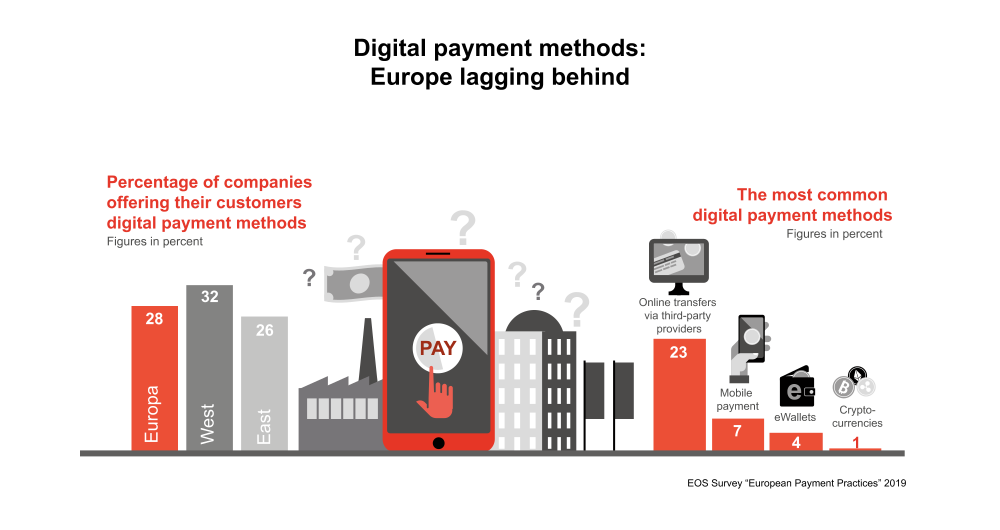
The survey found that only 28 percent of European companies offer digital payments at all – although by 2023 more than 75 percent of the population will be using digital payment methods, according to a forecast by data service provider Statista. “Companies that don’t adapt to this development are putting their competitiveness at risk. Long-established large companies in particular need to offer such functions, above all e-wallet solutions,” says Klaus Engberding, Chairman of the Board of Directors of EOS Group, “but many companies are lagging behind.”
In Eastern Europe the availability of digital payment was actually reduced.
In this context there are significant regional differences. In Western Europe, a third of all companies (32 percent) offer digital payment – an increase of six percent on the previous year. In Eastern European countries it is only around a quarter (26 percent) – compared with 30 percent in the previous year.
The options for paying with e-wallets are particularly scarce. For private customers and consumers, only 6 percent of European companies offer such a function, while only 3 percent offer it to business customers. The most common forms of payment are online transfers via third-party providers, offered by 20 percent of companies to private customers and by 24 percent to business customers. Mobile payment functions have increased very slightly, from 5 to 7 percent. Here too, there is a significant East-West divide. In the Western European countries there was an increase from 6 to 10 percent, whereas in the East it stayed at 5 percent. At just 1 percent, cryptocurrencies hardly get a mention.
Cyber security is not always convenient – but there is no alternative. If we want the e-commerce innovations that will be possible with PSD2 then there is no way around it.
What PSD2 means for companies
“PSD2 should induce companies to extend their digital payment options,” says Engberding. “The final phase of the regulations will come into force. This obliges them to review their existing arrangements in any case.” For example, every payment service provider needs a license from Bafin, the German Federal Financial Supervisory Authority, or equivalent agency in another EU country. What is known as “strong customer authentication” will be mandatory. For online and card payments, customers have to confirm two security features such as a PIN and a TAN (transaction number), whereby the TAN may be produced only in digital form, as paper TAN lists are no longer allowed. Companies that do not offer in that case PSD2-compliant payments risk penalties and fines.

“Confusion among customers in the next few months is inevitable. Familiar payment processes and banking apps will suddenly no longer work like they used to,” says Engberding. “Cyber security is not always convenient – but there is no alternative. If we want the e-commerce innovations that will be possible with PSD2 then there is no way around it.”
Download free EOS survey now. Link to survey portal
Please contact us if you would like more information.
Photo credits: visual space / Getty Images, Thomas Kappes, Jann Klee / EOS
Istražite više od EOS-a