
Digitalization: Europe’s not doing enough.
Europe’s businesses give themselves a pretty bad grade when it comes to digitalization, as the latest EOS survey “European Payment Practices” 2019 shows. Cause for concern: it’s been like this for years.
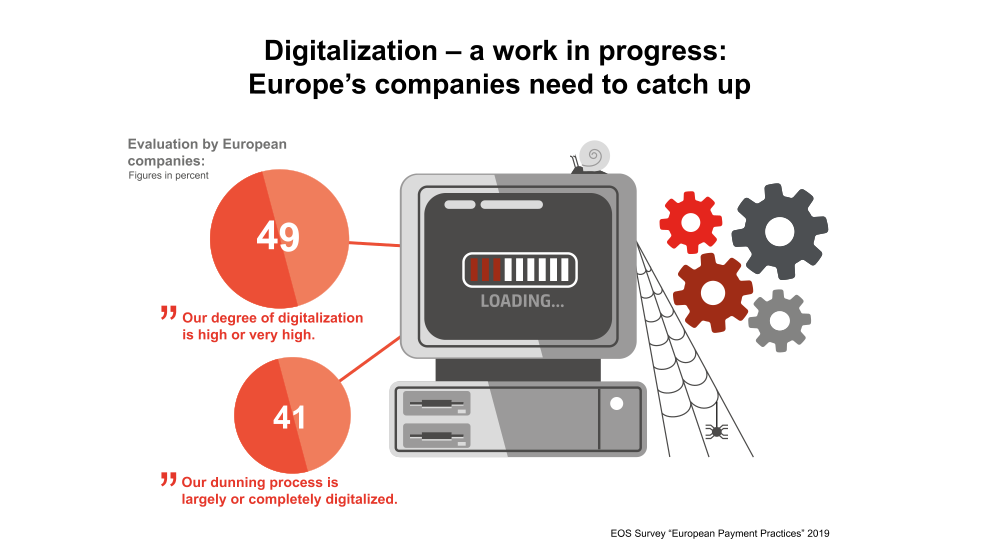
- Only 49 percent of the companies in Europe consider their degree of digitalization to be high or very high.
- Differences between the countries are great; German companies in particular rate themselves poorly.
- Europe’s digitalization jam is especially massive in the area of dunning – here, the majority still rely on manual processes.
Overall, Europe’s companies do not see themselves in a good light when it comes to digitalization: this is shown by the latest EOS survey “European Payment Practices” 2019. Only 49 percent of the 3400 respondents from 17 countries consider their own companies to be digitized enough. “And this average number hasn’t changed since 2017,” says Justus Hecking-Veltman, Chief Financial Officer of the EOS Group.
According to the EOS survey, Eastern European companies from the Czech Republic (60 percent), Slovakia, Hungary, and Greece (57 percent each) consider themselves to be highly to very highly digitized. In Western Europe, Belgium (58 percent) and the United Kingdom (55 percent) take the lead – Germany comes in last with 26 percent.
The fact that German companies rate themselves so much worse than their European neighbors do is astounding. The situation looks different if, for example, the respondents’ assessments from the EOS survey are compared with the DESI index: this European index, which measures the degree of digitalization of a country by means of objective criteria, puts Germany in 12th place among the 28 EU Member States.
“Digitalization is a long-term process that requires substantial financial resources in addition to the right mindset,” stresses Hecking-Veltman. “At EOS, for example, alone in the last fiscal year we invested around ten million euros in the digital transformation of our core debt collection systems. Regardless of whether a company classifies itself as a digital pioneer or a laggard – none of them would be well advised to rest on their laurels.”

Major regional differences.
However, it would be too easy to call Europe digitally regressive in general: in fact, there are big differences between countries and industries. According to the DESI index, for example, the wholesale trade and the automotive industry are more digitized than chemical and textile manufacturers are. Comparisons with the US, too, show a more complex picture. For example, large operators of online platforms and cloud computing centers may be lacking in Europe, but companies here are leading in the implementation of the Internet of Things (IoT): according to a study conducted by the management consulting firm Bain, European industrial companies implement IoT projects three times as fast as their US competitors do. Automotive groups especially have gained a good lead in Industry 4.0.
A manual, analog dunning process is not only prone to error, but it also usually does not reach the customer on the individually most suitable communication channel at the best possible time.
Regarding market conditions, too, Europe isn’t always as bad as it is said to be. Thus, according to the OECD economic outlook, the share of employees who do not have sufficient digital skills is lower in countries such as Germany, Belgium, and the UK than in the US. And the hurdles for cross-border digital trade are usually hardly higher or even lower in Europe than in the US – if exceptions such as Poland and Russia are excluded.
Poland (along with Greece, Romania, and Bulgaria) also brings up the rear in the DESI overall assessment of the economy and society: factors such as the quality of the broadband network and the digital skills among the workforce flow into this index. Finland, Sweden, the Netherlands, and Denmark are leading here.
With regard to the digitalization extent in European receivables management, there is a need to catch up: of the companies surveyed in the EOS survey, only 41 percent have a largely or completely digitized dunning process. “A manual, analog dunning process is not only prone to error, but it also usually does not reach the customer on the individually most suitable communication channel at the best possible time,” warns Hecking-Veltman. “There is an acute need for action here to reduce payment defaults.”
Please contact us if you would like more information.
Photo credits: Hero Images / Getty Images, Jann Klee / EOS
Udforsk mere fra EOS